

High-speed PCB design has entered a new era where a perfect layout no longer guarantees success. As edge rates climb, from fast switching power stages to DDR5, PCIe Gen 5, and other multi-gigabit interfaces, the PCB trace is only one part of the signal channel.
In real designs, signal integrity isn’t defined by routing alone. Parasitics and component choices play a major role, and these often determine whether a board works on the first prototype or ends up needing weeks of debugging.
A design can meet every routing guideline and still fail because two "equivalent" components behave very differently at high frequencies.
This article covers what experienced hardware engineers know that datasheets don't always tell you: why layout alone isn't enough for reliable high-speed PCB design.
Key Takeaways
- Signal integrity is determined by the entire signal path, where packages, vias, and return paths introduce parasitics.
- A clean layout isn’t enough; package inductance, ESR/ESL, and part behavior at high frequency often decide whether a design works on the first build.
- Package selection directly impacts parasitics, switching performance, and overall signal behavior in high-speed designs.
- Early component evaluation using parametric tools is essential. Octopart helps engineers compare packages, logic families, and alternates to balance performance, availability, and risk before prototyping.
Your PCB Is Only One Part of the Channel
A high-speed signal does not travel through the PCB alone. It moves through the transmitting IC, its package and pins, the PCB pads and vias, traces, connectors or cables, the receiving device, and the return path. Each stage adds small amounts of resistance, inductance, and capacitance that affect signal integrity.
Individually, these parasitics seem small. Together, they can cause reflections, jitter, EMI, and even communication errors. This is why two boards with the same routing can perform differently when packages, connectors, or components change.
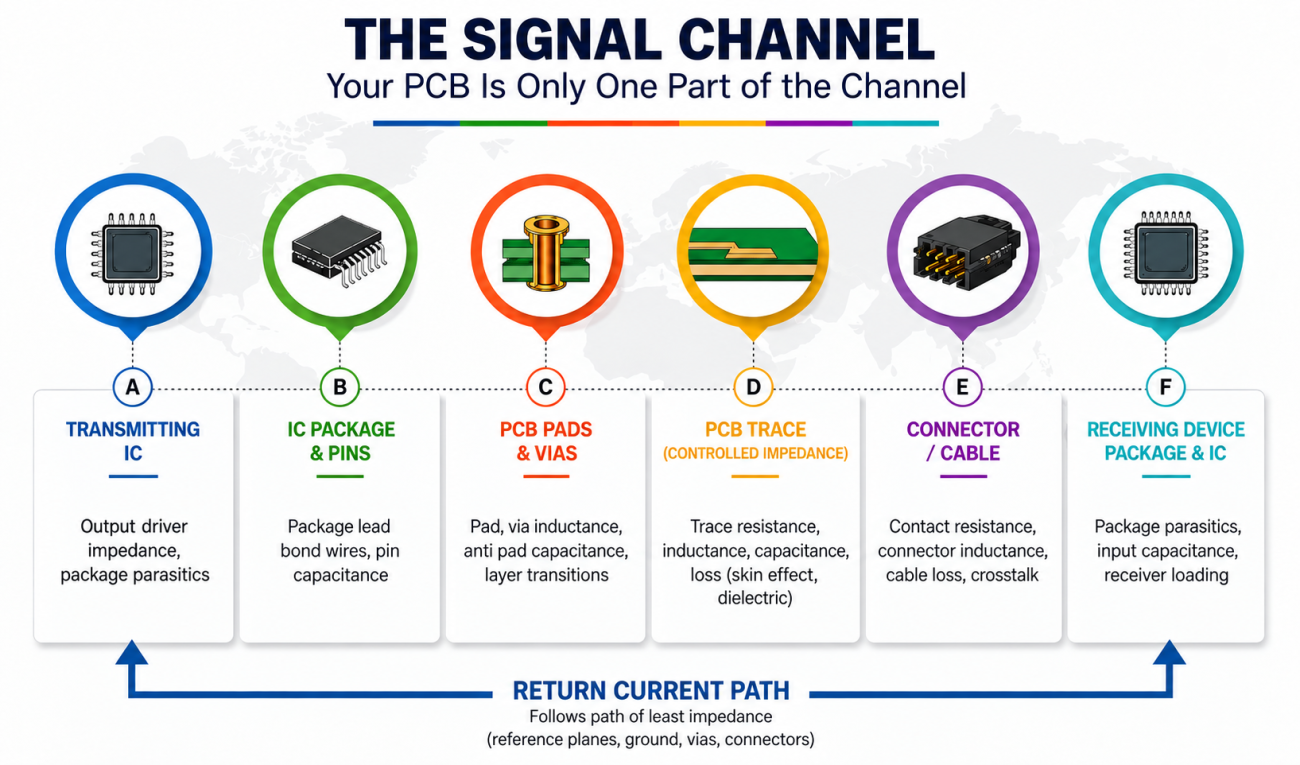
For today's high-speed designs, the real question is no longer: "Is my PCB layout correct?" Instead, it becomes: "Does the entire signal path behave as expected?"
Good Layout Is Necessary, But No Longer Sufficient
An industry survey found that 30% of PCB designers named signal integrity problems as a common cause of design overruns, highlighting that good layout alone is no longer sufficient.
A well-designed PCB layout remains the foundation of any high-speed design with controlled impedance, carefully designed stackups, continuous reference planes, differential pairs, minimal via transitions, and well-defined return paths that all help preserve signal quality.
Engineers still follow proven routing strategies to maintain good signal integrity:
- Match differential pair lengths
- Minimize unnecessary vias
- Reduce stubs
- Avoid routing across split reference planes
Just as important is the return-current path. At high frequencies, current doesn’t simply take the shortest path; it follows the path of lowest impedance. When the reference plane is interrupted, return currents are forced to take a longer path, increasing loop area and leading to higher noise, EMI, and signal degradation.
This is why modern high-speed designs require engineers to consider the entire signal channel, from PCB routing and component packages to power delivery and part selection.
Component packages affect far more than assembly and thermal performance. They directly influence electrical behavior.
At lower frequencies, package parasitics like inductance and resistance are easy to ignore. But in high-speed switching applications, those same effects start to matter, shaping waveform quality, efficiency, and overall reliability.
Take two MOSFETs with identical electrical specs. One comes in a traditional SOIC package, while the other uses a compact DFN package.
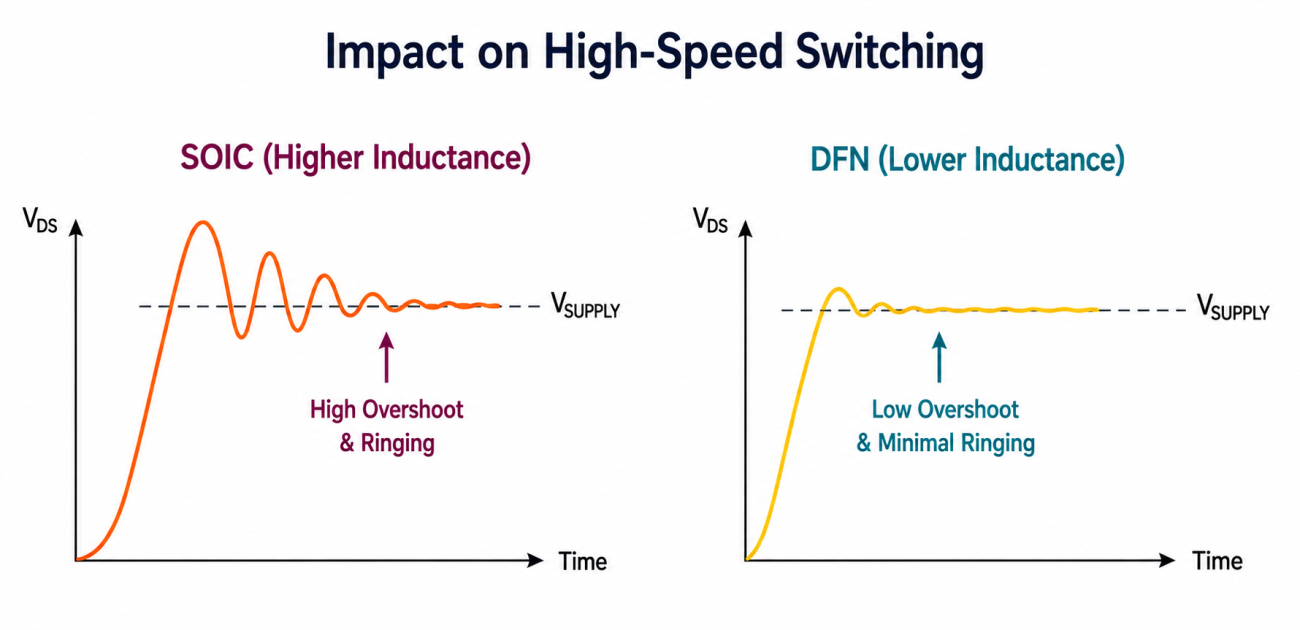
Both may share the same on-resistance and current rating, but the DFN package has shorter electrical paths and lower inductance, which reduces voltage overshoot, ringing, and switching losses during fast switching.
The key takeaway is simple: choosing a package is no longer just a mechanical or manufacturing decision, but an electrical design decision that can directly affect signal integrity.
Decoupling Is About Frequency, Not Just Capacitance
One of the most common misconceptions in PCB design is that adding more capacitance automatically improves power integrity.
In reality, every capacitor is effective only over a limited frequency range defined by its ESR, ESL, and self-resonant frequency. As switching speeds increase, the power distribution network becomes highly frequency-dependent.
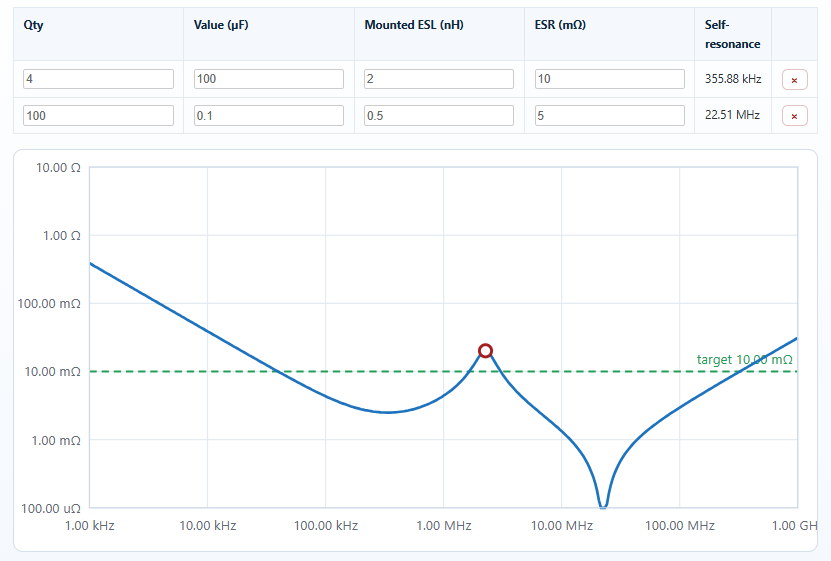
The first impedance plot shows a common mistake: combining only bulk and high-frequency capacitors. This creates a gap in mid-frequency coverage, resulting in a sharp impedance peak that exceeds the target and can lead to noise and instability.
The second plot improves this by adding mid-frequency capacitors. This helps reduce the impedance peak and improves coverage across a wider frequency range, although some resonance effects still remain.
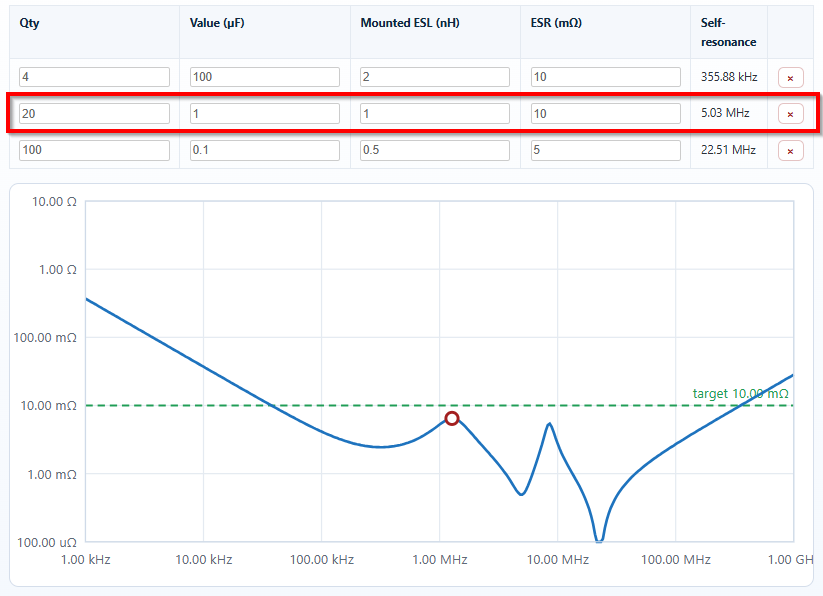
A well-designed PDN keeps impedance low and consistent across the operating range, which ensures stable power delivery in high-speed designs.
Component Selection Matters More Than Ever
As data rates climb, component choice matters just as much as the PCB layout.
Engineers need to look beyond basic specs and consider factors like ESR, ESL, package inductance, switching behavior, and logic families, since all of these have a direct impact on signal quality.
Evaluating these characteristics early helps engineers avoid costly redesigns and identify components that meet both electrical and supply chain requirements.
According to Aberdeen Group, engineers spend about 24% of their time correcting data integrity issues rather than designing, highlighting the importance of accurate, centralized component information.
That’s why experienced engineers use Octopart early in the design process to reduce this effort by having centralized component data, parametric search, datasheets, lifecycle information, and sourcing insights all in one place.
ESR: Looking Beyond Capacitance
Selecting a capacitor based only on capacitance and voltage rating is no longer sufficient. ESR plays a big role in the overall PDN impedance, and if it’s too low, it can create unwanted resonances. Engineers, therefore, optimize the complete impedance profile rather than a single component.
With Octopart's parametric search, engineers can quickly compare capacitors by capacitance, voltage, package, dielectric, and other key specifications while accessing datasheets to verify whether a part is suitable for high-speed decoupling applications.
.gif)
Package Inductance: More Than a Footprint
Package choice has a direct impact on switching performance. The SOIC and DFN MOSFET comparison above shows how much the package alone can change.
Octopart makes evaluation easier by allowing engineers to compare package variants side by side, reviewing electrical characteristics, lifecycle status, and sourcing options in one place, helping teams balance performance, availability, and cost before locking in a design.
Logic Families: Selecting for Signal Quality
The fastest logic device isn't always the right choice. Faster edge rates lead to ringing, overshoot, crosstalk, and EMI if they aren't controlled properly. In many designs, choosing the right logic family and applying proper termination results in cleaner, more reliable signals than simply going with the fastest option.
With Octopart, engineers can compare logic families such as HC, HCT, AHC, LVC, and LVT across multiple manufacturers, check inventory history to see whether stock has held steady, and identify alternate parts to balance performance, signal integrity, and sourcing risk early in the design process.
Conclusion
Signal integrity depends on the entire signal path, not just PCB routing. Package parasitics, ESR/ESL, and how components behave at high frequencies often set the real limits on performance. Decoupling also needs a frequency-focused approach, not just additional capacitance.
That’s why early component selection matters. Octopart lets engineers compare specs, check lifecycle status, see how many distributors stock a part, and evaluate alternates, helping reduce redesign risk and improve first-pass success.

Table of Contents
 Off Off Off